Table of Contents
Introduction to ISO 281
The ISO 281 standard is a vital guideline that outlines the principles and methodologies used for calculating bearing life in various applications. Published by the International Organization for Standardization, this standard addresses the interactions between loads, operating conditions, and material properties, offering a framework for determining the longevity of rolling bearings. ISO 281 equips engineers and manufacturers with tools to assess the reliability and performance of bearing systems across industries.
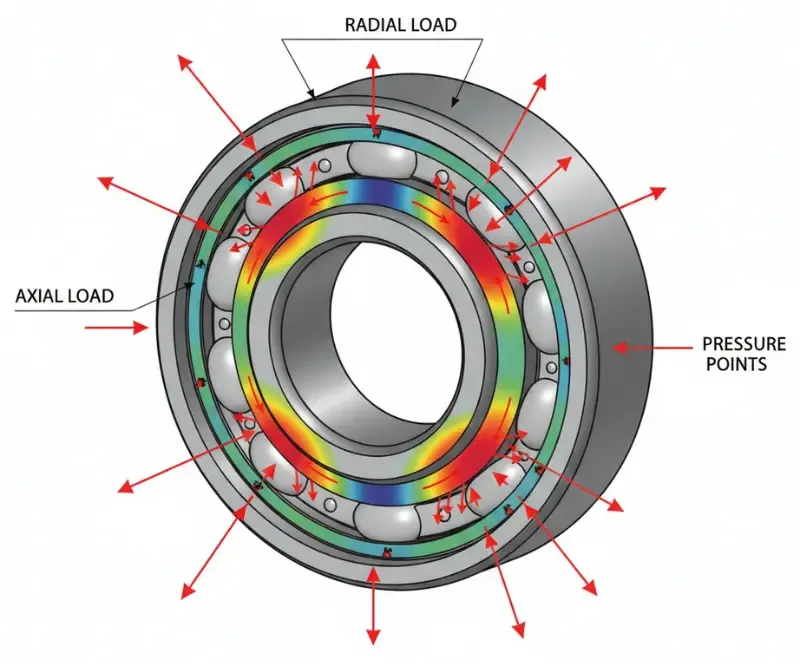
A key concept emphasized in ISO 281 is the equivalent bearing load, which integrates both radial and axial forces to predict the life expectancy of bearings accurately. By establishing a consistent calculation method, the standard allows users to estimate ISO 281 bearing life under various operating conditions. It also considers factors such as material properties, lubrication, and environmental influences, ensuring realistic life predictions.
Adopting ISO 281’s methodology enables manufacturers to optimize bearing design, enhance reliability, and plan maintenance schedules efficiently. In essence, ISO 281 provides benchmarks that help businesses maximize the efficiency of their bearing products.
Importance of ISO 281 in Industry
The ISO 281 standard plays a crucial role in industries that rely heavily on bearings, including manufacturing, automotive, and aerospace. By standardizing bearing life calculations, it ensures that engineers and designers can predict performance reliably, reduce unexpected machine downtime, and optimize operational efficiency.
In critical environments, following ISO 281 allows organizations to design bearings that meet consistent quality and reliability standards. It also establishes a common language among designers, engineers, and maintenance teams, improving collaboration and decision-making.
By applying ISO 281 principles, companies can extend the operational lifespan of equipment, minimize maintenance costs, and increase productivity. Using tools like the bearing life calculator helps implement predictive maintenance strategies, preventing wear-and-tear issues before they escalate.
Overview of Bearing Life Calculations
*Calculated based on ISO 281 Standards.
Bearing life calculations are essential for predicting the durability and reliability of bearings in real-world applications. ISO 281 provides a systematic approach for determining the basic rating life of bearings, taking into account factors such as load, speed, and operational conditions.
- Load: The primary determinant of bearing life is the applied load, including both radial and axial forces. The dynamic load rating specifies a bearing’s capacity under ideal conditions.
- Speed and Temperature: High rotational speeds increase heat, which can accelerate material degradation. Accurate calculations must consider operating temperature, lubrication, and contamination.
ISO 281 offers equations to determine bearing life in hours or kilometers, enabling precise maintenance scheduling and reliable equipment operation. Organizations can optimize system performance by aligning maintenance with calculated bearing lifespan, ensuring smooth operation.
Key Formulas in ISO 281
The primary formula in ISO 281 for calculating bearing life is: L10=(CF)3×1,000,000L_{10} = \left( \frac{C}{F} \right)^3 \times 1,000,000L10=(FC)3×1,000,000
Where:
- L10L_{10}L10 = expected life in million revolutions
- CCC = basic dynamic load rating (N)
- FFF = equivalent dynamic load (N)
This formula allows engineers to estimate bearing lifespan under specified loads. ISO 281 also provides adjustment factors:
- a1a_1a1 – adjusts for bearing arrangement and lubrication
- a2a_2a2 – adjusts for desired reliability level
Applying these calculations helps select bearings suitable for specific operating conditions, ensuring reliability and reducing maintenance costs.
This curve visualizes how service life decreases exponentially as the applied load increases, following the ISO 281 mathematical model.
Applications of ISO 281 in Real Life
ISO 281 has real-world applications in multiple sectors:
- Manufacturing: High-speed machinery, like textile spinning equipment, can benefit from ISO 281 by predicting bearing life and reducing downtime.
- Automotive: Car manufacturers use the standard to design wheel bearings for extended service life, improving vehicle reliability.
- Aerospace: Aircraft engine bearings designed using ISO 281 withstand harsh conditions, enhancing safety and fuel efficiency.
These examples highlight the standard’s practical value in increasing machinery reliability and optimizing maintenance schedules.
Common Misconceptions about ISO 281
Some misconceptions about ISO 281 include:
- Only for high-performance bearings: In reality, it applies to all types of rolling bearings across industries.
- Calculations are too complex: Once understood, the formulas reflect basic principles of bearing dynamics.
- Results are absolute guarantees: ISO 281 provides statistical averages; real-life factors like lubrication and environment can influence actual performance.
Recognizing these nuances ensures accurate implementation and better maintenance planning.
Linking to the Bearing Life Calculator
To simplify ISO 281 implementation, professionals can use a bearing life calculator. By inputting load, speed, and bearing parameters, the tool predicts bearing lifespan in line with ISO 281 principles.
This calculator transforms theoretical calculations into practical, actionable data, supporting predictive maintenance and informed bearing selection.
Conclusion: The Relevance of ISO 281
ISO 281 is essential for any organization relying on rolling bearings. Its systematic approach ensures:
- Accurate bearing life prediction
- Optimized maintenance schedules
- Improved equipment reliability
- Reduced downtime and costs
By integrating ISO 281 guidelines into design and maintenance, companies can enhance operational efficiency, extend bearing life, and improve overall machinery performance.
Further Reading and Resources
For deeper insights into ISO 281:
- Official ISO documentation – primary reference for ISO 281.
- Books: Rolling Bearing Analysis by Theodore H. Brown – detailed bearing calculations and ISO standards.
- Online resources: ResearchGate, IEEE Xplore, ABMA guidelines.
- Industry forums & webinars – practical discussions and expert insights.