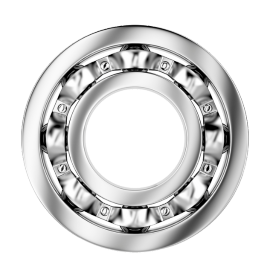
Bearing Vibration Standards & Technical Specifications
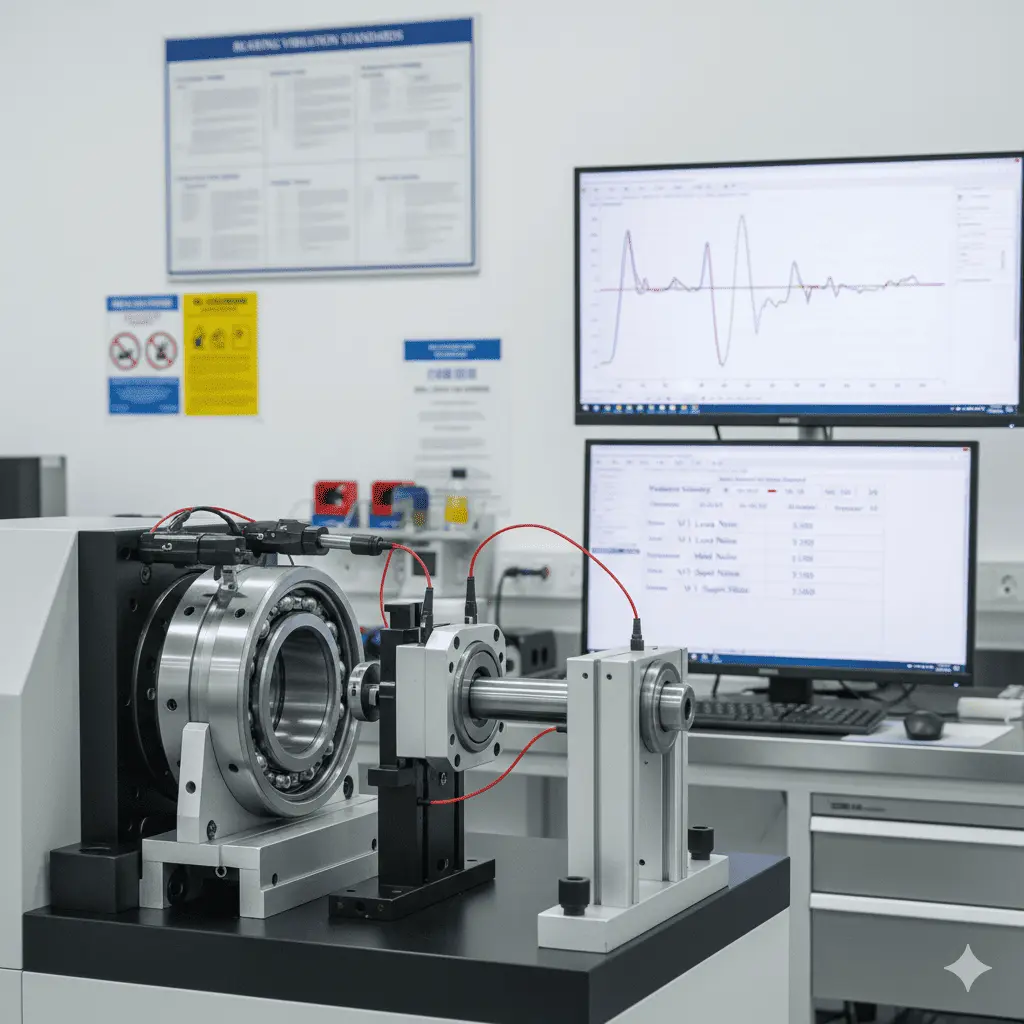
Bearing Vibration Standards are the primary indicators of a bearing’s manufacturing quality and rotational smoothness. In the demanding world of industrial engineering, excessive vibration is more than just an annoyance—it is a sign of internal friction, misalignment, or surface defects that can lead to catastrophic system failure. By adhering to international Bearing Vibration Standards, ZGBK ensures that every component provides the silent operation required for precision applications. For a complete understanding of how materials impact these levels, refer to our technical guide on Materials & Accuracy Standards.
Vibration Velocity Limit Chart (V1, V2, V3)
| Bore Diameter (mm) | V1 Grade (Standard) | V2 Grade (Low Noise) | V3 Grade (Super Silent) | ||||||
|---|---|---|---|---|---|---|---|---|---|
| Low | Med | High | Low | Med | High | Low | Med | High | |
| 5 – 6 | 90 | 60 | 50 | 58 | 36 | 33 | 35 | 21 | 18 |
| 7 – 9 | 110 | 80 | 65 | 72 | 48 | 40 | 44 | 28 | 24 |
| 10 – 12 | 140 | 100 | 85 | 90 | 60 | 50 | 55 | 35 | 30 |
| 15 – 17 | 180 | 130 | 100 | 115 | 75 | 60 | 70 | 45 | 36 |
| 20 – 25 | 230 | 160 | 130 | 150 | 100 | 80 | 90 | 60 | 48 |
| 28 – 32 | 290 | 210 | 170 | 190 | 130 | 100 | 115 | 75 | 60 |
| 35 – 40 | 380 | 260 | 210 | 240 | 160 | 130 | 150 | 100 | 80 |
| 45 – 50 | 480 | 330 | 260 | 300 | 200 | 160 | 190 | 130 | 100 |
| 55 – 60 | 600 | 420 | 340 | 380 | 260 | 210 | 240 | 160 | 130 |
| 65 – 70 | 750 | 520 | 420 | 480 | 330 | 260 | 300 | 200 | 160 |
| 75 – 100 | 1450 | 1000 | 800 | 950 | 650 | 520 | 600 | 420 | 340 |
Technical Vibration Analysis & Testing
To ensure 100% compliance with Bearing Vibration Standards, ZGBK utilizes high-precision transducers that measure velocity in micrometers per second (µm/s). The testing environment is strictly controlled to eliminate external interference. Vibration is analyzed across three critical frequency bands: the Low Band (detects unbalance), the Medium Band (detects raceway waviness), and the High Band (detects surface roughness and dust contamination). This thorough testing protocol is what allows us to guarantee the performance of our V2 and V3 silent series.
Understanding Noise Grades (V vs Z)
A common question in the industry involves the difference between V-Grade and Z-Grade. While both are part of Bearing Vibration Standards, they measure different physical properties. V-Grade (V1, V2, V3) measures vibration velocity, which is the best indicator of a bearing’s overall structural integrity. Z-Grade (Z1, Z2, Z3) measures vibration acceleration in decibels (dB), which correlates more closely to the high-pitched audible noise humans hear. For electric motors, both metrics are often used in tandem to ensure a premium, silent user experience.
Environmental Factors Affecting Vibration
Even the highest quality bearing following strict Bearing Vibration Standards can exhibit noise if environmental factors are not managed. Factors such as lubricant viscosity, ambient temperature, and external resonance from the machine housing can amplify vibration signals. ZGBK recommends using high-purity synthetic greases for applications where noise reduction is the primary objective. Furthermore, ensuring that the bearing seat is machined to the correct tolerances will prevent deformation of the rings, which is a leading cause of vibration.
Predictive Maintenance & Installation
Maintaining Bearing Vibration Standards throughout the machine’s life cycle requires a proactive approach. Predictive maintenance using handheld vibration pens or permanently mounted sensors allows engineers to detect early warning signs of wear. By comparing field data against our original Bearing Vibration Standards chart, maintenance teams can schedule replacements before a failure occurs. Proper installation using induction heaters and precision alignment tools is also vital. A bearing that is “forced” onto a shaft will immediately lose its V3 rating due to internal stresses.