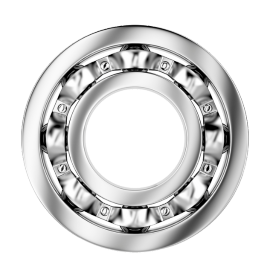
What Is Bearing Life?
Bearing life refers to the number of revolutions or operating hours a rolling bearing can achieve before the first signs of material fatigue occur on the raceways or rolling elements.
In bearing engineering, bearing life is not expressed as an exact value, but as a statistical life. The most commonly used standard is the L10 basic rating life, defined by ISO 281.
L10 life means that 90% of a sufficiently large group of identical bearings can be expected to reach or exceed this life under the same operating conditions.
What Is L10 Bearing Life?
The L10 bearing life (also called basic rating life) is a theoretical value used for:
Bearing selection and sizing
Mechanical design validation
Reliability estimation
Maintenance planning
It assumes:
Proper mounting
Correct lubrication
Normal operating temperature
Clean working conditions
L10 life can be expressed in:
Million revolutions, or
Operating hours (L10h) at a given speed
ISO 281 Bearing Life Formula
According to ISO 281, the basic rating life is calculated using the following equation:
L10 = (C / P)^p
Where:
L10 = Basic rating life (million revolutions)
C = Basic dynamic load rating (kN)
P = Equivalent dynamic bearing load (kN)
p = Life exponent
Ball bearings: p = 3
Roller bearings: p = 10/3
To convert L10 life into operating hours:
L10h = (L10 × 10⁶) / (60 × n)
Where:
L10h = Bearing life in hours
n = Rotational speed (rpm)
Bearing Life Calculator
⚠️ Note: The result represents a theoretical value under ideal operating conditions and should be used as a reference for design and selection.
Technical Resource Center
Looking for specific technical drawings? Download 2D/3D models and data sheets here.
Download PDF Drawings
Standard Bearing Products
Explore our catalog of high-speed stainless steel bearings for household appliances.
View Product ListBearing Life Calculator
Calculate the basic rating life (L10) of rolling bearings according to ISO 281.
L10 Life: million revolutions
L10h Life: hours
Factors Affecting Actual Bearing Life
Although ISO 281 provides a standardized calculation method, the actual service life of a bearing can differ significantly due to real operating conditions, including:
Load Conditions
Higher loads significantly reduce bearing life
Shock loads and vibration accelerate fatigue
Speed
Higher rotational speeds increase the number of stress cycles
Excessive speed can lead to lubrication failure
Lubrication
Inadequate lubrication is one of the most common causes of premature bearing failure
Proper grease or oil selection is critical
Contamination
Dust, moisture, and metal particles shorten bearing life
Effective sealing greatly improves reliability
Mounting and Alignment
Misalignment causes uneven load distribution
Incorrect installation can reduce life dramatically
Limitations of L10 Life Calculation
It is important to understand that L10 life does not represent the maximum bearing life. Instead, it is a statistically defined minimum life for reliable design.
The calculation does not fully account for:
Extreme temperatures
Corrosion
Poor lubrication practices
Improper shaft or housing tolerances
For critical applications, additional correction factors or advanced life models may be required.
Bearing Life Calculation for Engineering Design
Bearing life calculation is widely used in:
Industrial machinery
Automotive systems
Electric motors
Gearboxes
Agricultural and construction equipment
Engineers use L10 life values to balance:
Load capacity
Bearing size
Cost efficiency
Reliability targets
Deepen Your Engineering Knowledge
Understanding ISO 281 Bearing Life Standard
A detailed technical breakdown of the international standards used to calculate bearing longevity and reliability.
What is L10 Bearing Life? A Simple Guide
Discover the meaning behind the 90% reliability metric and how it impacts your maintenance and safety cycles.
The Essential Guide to Ball Bearings
Explore the fundamental design, internal components, and diverse industrial applications of modern ball bearings.