What L10 Actually Means
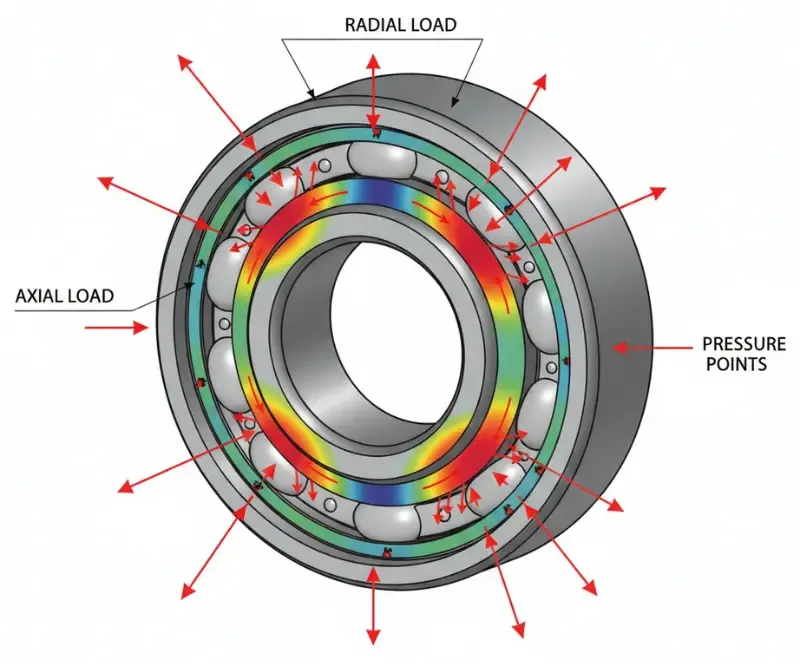
L10 bearing life is a fundamental reliability metric used in bearing engineering and machinery design. It represents the number of operating hours at which 90% of a group of identical bearings are expected to remain operational under the same load and speed conditions. In practical terms, this means that at the specified L10 life, only 10% of the bearings are statistically expected to fail due to fatigue.
Unlike a simple “average lifespan,” L10 is based on statistical reliability rather than individual performance. In any real-world application, some bearings will fail earlier than others due to material variability, manufacturing tolerances, lubrication conditions, or operating environments. L10 provides a conservative and realistic benchmark that engineers can use for design and maintenance planning.
In many industries—including automotive, power generation, industrial machinery, and heavy equipment—L10 life is used as a standard measure of bearing performance. Engineers often analyze bearing life distribution curves, where the L10 point is clearly marked as the threshold at which 90% of bearings are still functioning. This helps visualize the probability of failure over time.
Understanding L10 bearing life is essential for selecting the right industrial bearings for a given application, predicting maintenance intervals, and reducing unexpected downtime. Rather than relying on guesswork, engineers use standardized formulas and tools—such as an online bearing life calculator—to estimate L10 based on load, speed, and bearing specifications.
Want to estimate L10 for your application?
Use our online bearing life calculator to get fast and accurate results.
Why Engineers Use L10 Instead of “Average Life”
Engineers prefer L10 bearing life over average life because it provides a more reliable and conservative assessment of performance.
Traditional “average life” typically corresponds to L50, meaning that 50% of bearings are expected to fail before that point. While useful in some statistical analyses, L50 is often too optimistic for critical engineering applications where reliability is essential.
L10, on the other hand, represents a 90% survival rate, making it a safer and more practical metric for real-world design. This is particularly important in industries such as automotive, aerospace, manufacturing, and energy, where bearing failure can lead to costly downtime, safety risks, or catastrophic system breakdowns.
By using L10, engineers can better:
- Predict realistic service life
- Design more reliable systems
- Set appropriate maintenance schedules
- Reduce unexpected failures
In high-load and high-speed environments, average life metrics may significantly underestimate failure risk. L10 accounts for statistical variability and provides a clearer picture of bearing durability under real operating conditions.
Ultimately, L10 helps engineers make safer, more informed decisions—balancing performance, cost, and reliability when selecting ball bearings and rolling bearings.
L10 vs L50 vs L90
Understanding the differences between L10, L50, and L90 is crucial for proper bearing selection:
L10 Bearing Life
- 90% of bearings are expected to survive this long
- Most commonly used in engineering and industry
- Considered the standard reliability benchmark
L50 Bearing Life
- 50% of bearings are expected to survive this long
- Represents the median life
- Useful for general performance estimation but less reliable for critical applications
L90 Bearing Life
- Only 10% of bearings are expected to survive this long
- Used in highly conservative designs
- Common in safety-critical systems such as medical devices, aviation, or nuclear applications
Which one should you use?
- If reliability is critical → Use L10 or L90
- If you want general performance trends → Use L50
- For most industrial applications → L10 is the best standard choice
Understanding these differences helps engineers match bearing performance expectations with real operational needs and choose the right ZGBK bearings accordingly.
When to Use L10 Bearing Life
L10 bearing life is most useful in applications involving rotating machinery, including:
- Electric motors
- Turbines
- Pumps
- Gearboxes
- Conveyors
- Industrial fans
In high-load or high-speed systems, selecting a bearing with an appropriate L10 rating helps improve reliability and reduce failure risk. However, L10 should not be used in isolation.
Engineers should also consider:
- Applied load
- Rotational speed
- Operating temperature
- Lubrication quality
- Alignment accuracy
- Contamination levels
Using a bearing life calculator allows engineers to input these variables and obtain a more precise L10 estimate tailored to their specific application.
Common mistakes when applying L10 include:
- Ignoring real operating loads
- Assuming ideal lubrication conditions
- Neglecting temperature effects
- Using catalog ratings without adjustment
Best practice is to combine L10 calculations with real-world operating data and safety margins.
Conclusion
L10 bearing life is a powerful and practical reliability metric that helps engineers design safer, more efficient, and longer-lasting mechanical systems. By understanding how L10 works and how to apply it correctly, engineers can optimize bearing selection, minimize downtime, and improve overall machine performance.
Try it yourself:
Calculate your bearing’s L10 life using our online bearing life calculator.
If you need actual products, explore our ZGBK bearing range.